
Heat management is the single most important factor in achieving a great hookah session. Too much heat scorches the tobacco, too little produces thin, flavourless clouds. For decades, aluminium foil was the only option, but heat management devices (HMDs) have revolutionised how we control heat at the bowl. This complete guide covers everything you need to know about HMDs, from how they work to which one suits your setup best.
What Is a Heat Management Device?
A heat management device is a metal apparatus that sits on top of your hookah bowl in place of aluminium foil. It holds your charcoal inside an enclosed or semi-enclosed chamber, distributing heat evenly across the tobacco below. Most HMDs are made from aluminium alloy or stainless steel and feature adjustable vents that let you fine-tune airflow and temperature throughout your session.
The concept is straightforward: rather than placing coals directly on perforated foil where heat can create hotspots, an HMD acts as a buffer. The metal body absorbs heat from the coals and radiates it uniformly across the bowl surface. This means more consistent flavour, longer sessions, and far less risk of burning your shisha.
How HMDs Work vs Traditional Foil
With a traditional foil and coal setup, you place perforated aluminium foil tightly over the bowl, then position coals on top. Heat transfers directly through the thin foil to the tobacco. This method works well but requires constant attention — you need to rotate coals, adjust their position, and manage ash buildup to avoid hotspots.
An HMD changes this dynamic entirely. The device walls absorb and redistribute heat, creating an oven-like environment inside the bowl. Temperature changes happen more gradually, giving you a larger window to react before the tobacco starts to burn. Most HMDs also trap some heat when the lid is closed, meaning you can often use fewer coals than a foil setup requires.
Key Differences at a Glance
- Heat distribution: HMDs spread heat evenly; foil creates localised hotspots under each coal
- Session length: HMDs typically extend sessions by 15-30 minutes due to better heat retention
- Ease of use: HMDs require less coal management during the session
- Flavour consistency: More stable temperatures mean steadier flavour from start to finish
- Setup time: Foil is quicker to set up; HMDs need preheating
- Cost: Foil is far cheaper; HMDs are a one-time investment
Popular Heat Management Devices Compared
Kaloud Lotus
The Kaloud Lotus is the original HMD and remains the industry benchmark. Made from anodised aluminium, it features a two-piece design with a base that holds two to three coals and a rotating lid with adjustable vents. The Lotus I Plus improved on the original with better heat distribution and a redesigned vent system. It fits most standard phunnel bowls and delivers exceptionally consistent heat.
The Lotus excels at low-and-slow sessions. Its thick aluminium walls retain heat brilliantly, and the vent system provides precise control. The main drawback is price — it is one of the more expensive HMDs on the market — but many enthusiasts consider it a worthwhile investment that pays for itself in improved session quality.
Apple On Top (AOT)
The Apple On Top Provost is a more affordable alternative that has earned a loyal following. Its distinctive raised design allows it to sit above the foil rather than replacing it entirely — you use foil on the bowl and place the AOT on top. This hybrid approach gives you the heat management benefits of an HMD while maintaining the simplicity of foil underneath.
The AOT Provost works particularly well with overpacked bowls since the raised design provides clearance between the tobacco and the heat source. It is also lighter than the Lotus, making it suitable for smaller or more delicate bowls.
Oduman Ignis
The Oduman Ignis offers a budget-friendly entry into HMD territory. It features a simple design with a removable lid and generous coal capacity. While it lacks the precision vent control of the Lotus, it delivers solid performance at a fraction of the price. The Ignis is an excellent choice for beginners who want to try an HMD before committing to a premium option.
HMD vs Foil: Detailed Pros and Cons
Advantages of Using an HMD
- Consistent heat distribution eliminates the constant coal rotation that foil demands
- Longer sessions thanks to superior heat retention in the metal body
- Cleaner experience — no ash falling through foil holes into your tobacco
- Less coal consumption in many setups, as trapped heat reduces waste
- Easier for beginners who struggle with foil heat management
- Reduced risk of burnt tobacco thanks to the heat buffer effect
Advantages of Using Foil
- Lower cost — a roll of foil lasts hundreds of sessions
- Universal compatibility with any bowl shape or size
- Faster heat-up time since there is no metal mass to preheat
- Greater control for experts who know how to manage coal placement precisely
- No cleaning required — simply discard the foil after each session
- Traditional experience preferred by many seasoned smokers
How to Use an HMD Properly
Getting the best results from your HMD requires proper technique. Follow these steps for an optimal session:
Step 1: Pack Your Bowl Correctly
Pack your shisha just below the rim of the bowl. With an HMD, you want a slight gap between the tobacco surface and the bottom of the device. This prevents the shisha from sticking to the HMD and allows proper airflow. A fluffy pack works best for most HMD setups.
Step 2: Preheat the HMD
Place your fully lit natural coals inside the HMD while it sits on a heat-safe surface — not on the bowl yet. Let the device heat up for two to three minutes. This preheating step ensures even heat distribution from the very first pull.
Step 3: Place and Adjust
Set the preheated HMD on your packed bowl. Start with the vents fully open to allow maximum airflow as the bowl warms up. After five to ten minutes, begin closing the vents gradually to increase the temperature. The goal is to find the sweet spot where you get thick, flavourful clouds without any harshness.
Step 4: Manage Throughout the Session
Check your coals every 20-30 minutes. Unlike foil, you do not need to rotate coals constantly, but you should replace spent coals and adjust vent positions as the session progresses. If the smoke becomes harsh, open the vents or briefly remove the lid to release excess heat.
Coal Placement Inside Your HMD
How you arrange coals inside the HMD affects heat distribution significantly. With two coals, place them on opposite sides of the device for balanced heat. With three coals, arrange them in a triangle pattern. Avoid stacking coals vertically as this concentrates heat in one area and can cause burning.
Flat coals work better in most HMDs than cube coals because they maximise contact with the device floor, improving heat transfer. If you use cube coals, stand them on their edges initially to reduce the contact area and prevent overheating during the first few minutes.
Vent Control Techniques
The vent system is what separates a good HMD session from a great one. Learn these principles:
- Vents open: Maximum airflow, lower temperature, lighter smoke
- Vents half-closed: Balanced airflow, moderate temperature, good clouds
- Vents closed: Minimal airflow, maximum temperature, dense smoke but risk of burning
- Start open, close gradually: This is the golden rule for HMD vent management
When to Use HMD vs Foil
Neither option is universally superior. Choose an HMD when you want a low-maintenance session with consistent flavour, when smoking with guests who are not experienced enough to manage foil, or when using premium tobacco that benefits from steady, even heat. Choose foil when using traditional clay bowls that do not fit standard HMDs, when you want maximum control over heat placement, or when smoking dark-leaf tobacco that benefits from direct high heat.
Cleaning Your HMD
Regular cleaning keeps your HMD performing at its best. After each session, let the device cool completely, then soak it in warm water with a small amount of washing-up liquid for 15-20 minutes. Use a non-abrasive sponge to remove any residue. For stubborn buildup, a paste of bicarbonate of soda and water works wonders. Avoid steel wool or harsh abrasives that can damage the anodised coating.
Deep clean your HMD every ten sessions by boiling it in water with a tablespoon of white vinegar for five minutes. This removes any oxidation and restores heat conductivity. Dry thoroughly after cleaning to prevent water spots and oxidation.
Best HMD for Different Bowl Types
Not every HMD fits every bowl. Here is a quick compatibility guide:
- Standard phunnel bowls: Kaloud Lotus or Oduman Ignis — both designed primarily for phunnel bowls
- Wide phunnel bowls: Kaloud Lotus I Plus with its larger diameter
- Traditional Egyptian bowls: AOT Provost with foil — sits on top without needing a lip to grip
- Vortex bowls: Most HMDs fit, but check diameter compatibility
- Small bowls: AOT Provost due to its lighter weight and smaller footprint
Heat management devices have transformed the hookah experience for countless enthusiasts. Whether you choose a premium Kaloud Lotus or start with a budget-friendly option, the improvement over foil in terms of convenience and consistency is undeniable. Experiment with vent positions and coal arrangements to find what works best for your preferred tobacco and hookah setup.
Coal Placement: Where You Start Matters
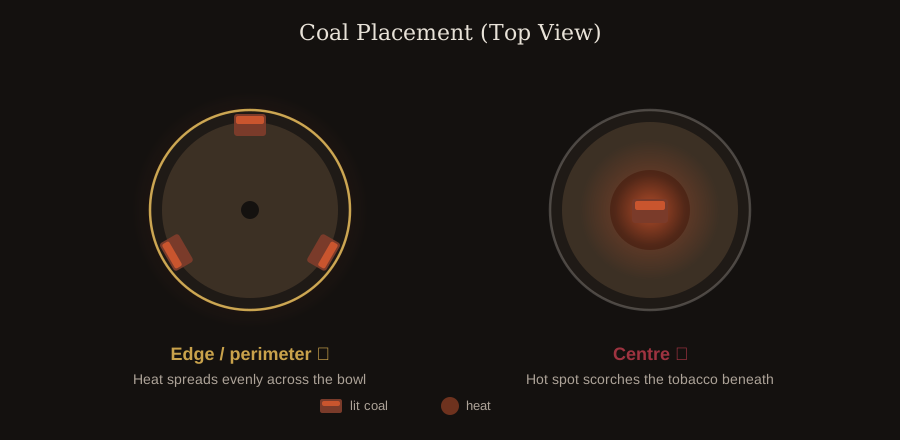
Most beginners pile coals in the centre of the bowl. This concentrates heat directly over the middle of the tobacco, which scorches it and produces the harsh, chemical taste that puts people off hookah early on. The correct starting position is the opposite:
- Place coals on the outer edge of the bowl, roughly evenly spaced around the perimeter. For a standard phunnel or Egyptian bowl, two cubes at 10 o'clock and 4 o'clock. Three cubes if you are using a larger bowl or the tobacco is packed densely.
- Leave the centre clear. Heat travels inward from the coals — the tobacco in the middle receives heat without a coal directly above it scorching it.
- Wait before drawing. Once coals are on, give it 3–5 minutes before your first pull. The heat needs time to distribute through the foil and into the tobacco. Drawing immediately through cold tobacco produces thin, flavourless smoke and tricks you into thinking the coal placement is wrong when it is actually just not ready yet.
How to Read a Session in Progress
The two main heat problems announce themselves clearly once you know what to look for:
Too hot: what it feels like
- Smoke is harsh in the throat — a dry, chemical, slightly acrid sensation rather than smooth flavour
- The flavour tastes like burnt sugar or scorched tobacco rather than the profile you expect
- Sessions sometimes start strong then go harsh after 15–20 minutes as heat accumulates
- The foil feels very hot to the back of your hand when held 2–3cm above it
Too cold: what it feels like
- Smoke is thin — large draws produce modest clouds and weak flavour
- No throat sensation even on long pulls
- The tobacco has not really "opened up" even 10 minutes in
- Pulling on the hose requires noticeably more effort than usual (slightly cold tobacco is more resistant)
Both problems are fixable mid-session. Neither means the session is over.
Managing Heat Mid-Session
If the smoke is too harsh
Remove one coal and set it aside on a heat-resistant surface or the edge of your coal tray. Wait two minutes, draw again. If it improves, leave the setup as is and put the removed coal back on when the session starts going thin. If it is still harsh, check whether your foil is pierced correctly — too few or too large holes reduce airflow and concentrate heat unevenly. Standard perforation is a spiral pattern from the edge inward, holes roughly 2mm apart, not piercing directly over the spire of a phunnel.
If the smoke is too thin
Move existing coals slightly toward the centre of the bowl. Even a centimetre inward raises the heat the tobacco receives without adding more coals. If it is still thin after two minutes, add a third coal on the outer edge. Thin smoke that does not respond to this usually means either the tobacco is dried out, the coals are not fully lit, or the bowl is packed too loosely.
The coal rotation
As natural coals burn, they shrink and produce ash on their surface. Ash insulates the coal and reduces the heat it delivers — the grey crust is not transferring heat the way the glowing core underneath is. Every 10–15 minutes, use your tongs to:
- Tap the ash off each coal gently over the tray
- Move the coals slightly inward to compensate for their smaller size
- Rotate their position so the same face is not always facing down
This one habit alone significantly extends session quality. Unrotated coals left in the same position gradually lose heat contact with the foil and the session goes thin prematurely.
When to Replace Coals
With quality coals (Cocourth, Titanium) you should get 60–80 minutes from the original set. The session typically goes like this:
- Minutes 0–5: Warming up. Thin smoke is normal. Do not panic.
- Minutes 5–25: Peak session. Good clouds, full flavour, tobacco producing at its best.
- Minutes 25–45: Slight decline. Rotate coals inward, tap ash. Session extends well.
- Minutes 45–60: Coals are around half their original size. Add one fresh coal on the outer edge to maintain heat, or replace all coals if starting a second bowl pack.
- Past 60 minutes: Tobacco is largely spent on most setups. You can push further with a third coal added earlier, but most of the flavour has been extracted by this point.
Common Heat Management Mistakes
- Adding coals when the smoke goes thin late in the session. Often the tobacco is simply spent — no amount of extra coal will recover flavour that is no longer there. Check the tobacco first before reaching for another cube.
- Using a wind cover indoors. Wind covers trap heat and can push an otherwise correct setup into harsh territory quickly. They are useful outdoors; indoors they frequently cause overheating.
- Putting coals on before they are fully lit. A partially lit natural coal produces harsh off-gases that you will draw through the session. Every face of the coal needs to be covered in grey ash with a glowing orange core before it goes on the bowl. No exceptions.
- Starting with three coals on a small bowl. A standard 18–22mm phunnel bowl does not need three coals to start. Two is usually the right starting point; three can overwhelm a small-volume bowl in the first 10 minutes.
Frequently Asked Questions
How do I know if my coals are causing a harsh session or if it is the tobacco?
Remove one coal and wait three minutes. If the harshness drops, it is a heat issue — too much coal for the setup. If the harshness stays regardless of coal adjustments, the tobacco is likely the problem — either it is dry and stale or the bowl pack is too dense. Try a fresh pinch of tobacco in a clean bowl to isolate which it is.
Why is my session always thin in the first few minutes?
This is normal. The tobacco needs time to warm through before it produces dense smoke. Three to five minutes of thin smoke at the start of a session is correct — it is not a sign that something is wrong. If it is still thin after 8–10 minutes, then the coals are cold, placed incorrectly, or not enough of them.
How many coals for a phunnel vs an Egyptian bowl?
A standard phunnel bowl (18–22mm spire) typically works well with two cubes to start. A large Egyptian bowl or a Harmony bowl with more surface area usually benefits from three. The principle is that coals go on the outer edge, and the outer edge of a larger bowl has more room — so more coals is not "hotter," it is simply spreading heat across a larger area.
Should I ash my coals into the tray or blow them?
Tapping with tongs over the tray is cleaner and more controlled than blowing. Blowing ash onto the foil or into the bowl is one of the ways tobacco gets contaminated mid-session. Use tongs, tap gently, and keep the ash in the tray where it belongs.
Can I reuse coals from the previous session?
Yes. Store them in a dry container and re-light fully next time — they reach temperature in 3–4 minutes rather than the usual 8–12. They will not last as long as fresh coals but are perfectly usable. Do not discard half-burnt coals.