The Main Parts of a Hookah
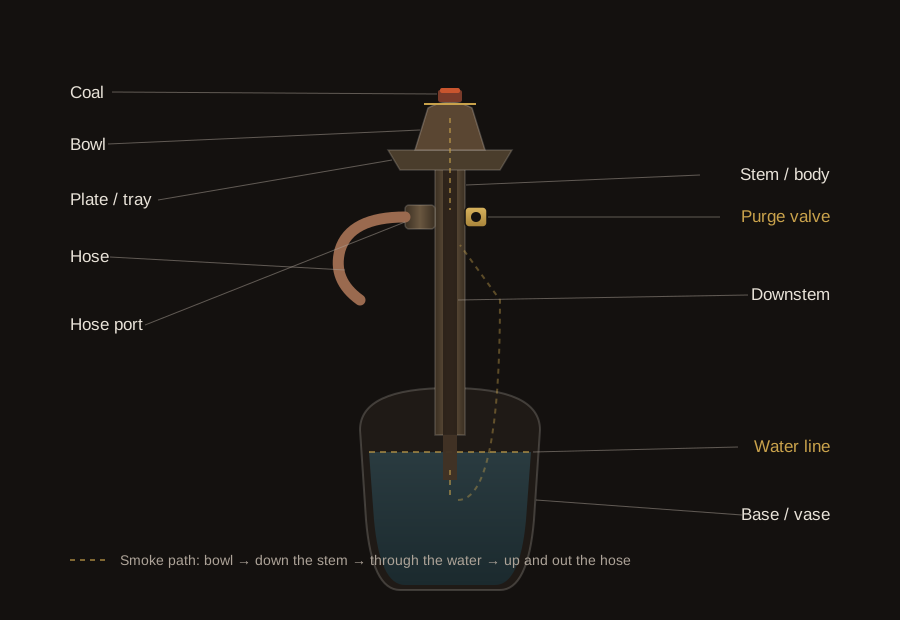
A hookah looks complicated the first time you see one, but it’s really just a sealed air path. Smoke is pulled from the bowl at the top, down through the stem, bubbled through water in the base, and back up through the hose to your mouth. Every part below exists to make that path work — or to seal it, so nothing leaks. Once you understand what each piece does, cleaning it, fixing it and buying the right replacement all get a lot easier.
The bowl (head)
The bowl sits at the very top and holds your shisha and the heat source above it. It’s the single part that most affects your session, because it controls how the tobacco cooks. Bowls come in clay, glazed ceramic, silicone and specialist designs like phunnel and vortex shapes, each managing heat and juice differently. Clay and unglazed ceramic hold heat well but can dry a mix out; silicone is nearly indestructible and forgiving for beginners. If you want to go deeper on shapes, the differences between the main hookah bowl types are worth reading before you buy, because the wrong bowl will fight you no matter how good your tobacco is.
Grommets and seals
Grommets are the small rubber or silicone rings that sit between parts — between the bowl and stem, the stem and base, and around the hose port. They’re unglamorous and easy to ignore, right up until one is missing or perished and your hookah won’t hold smoke. A hookah only works if it’s airtight, and grommets are what make the joints airtight. Silicone grommets last longer and tolerate heat better than the cheap rubber ones that often ship in the box, and they’re among the first things worth upgrading.
What is the metal plate on a hookah for?
The plate — also called the tray or ashtray — is there to catch falling ash, stray embers and bits of foil so they don’t land on your table or your lap. It sits around the stem just below the bowl. Beyond safety, it’s a handy resting spot for hot coals, tongs and a lid while you manage heat mid-session. Some plates lift off for cleaning; others are fixed to the stem. A wide plate is genuinely more useful than it looks once you’re moving coals around.
The stem (body and downstem)
The stem is the tall central column, and it’s the backbone of the whole hookah. The visible upper section is the body; the part that extends down inside the base and under the waterline is the downstem. Smoke travels down this tube, and the depth the downstem sits below the water sets how much the smoke is filtered and cooled. Stems are usually stainless steel, aluminium or brass. Stainless is the sweet spot for most people — it won’t corrode, it’s easy to clean, and it lasts for years. A wider stem generally gives an airier, more open draw.
What does the purge valve do?
The purge valve lets you push stale or harsh smoke out of the base instead of inhaling it. It’s a one-way valve, usually a small metal housing with a ball bearing inside, mounted on the stem above the waterline. Blow gently into the hose and the valve opens to vent the smoke out; draw normally and it stays shut so no air leaks in. It’s the fastest way to freshen a session that’s gone stale or to clear things after a coal change. If yours starts leaking or rattling, our explainer on how the hookah purge valve works covers the fix. Not every hookah has one, and a traditional single-hose setup is perfectly happy without it.
The base (vase)
The base — the vase or water bowl — holds the water that cools and filters your smoke, and it’s the wide vessel everything else sits on top of. It’s usually glass, sometimes acrylic. The job is simple but essential: as smoke bubbles up through the water, it loses heat and some particulates, which is what makes a hookah smooth rather than harsh. Fill it so the downstem sits roughly an inch or two below the surface — too much water makes the draw heavy and can gurgle up the stem, too little and you barely filter anything. The base is also usually the heaviest, most breakable part, so it’s worth handling with care.
The hose port
The hose port is the fitting on the stem where the hose connects, sealed with a grommet or a rubber gasket. Single-hose hookahs have one; multi-hose models have two or more, and any unused ports need a stopper or the hookah won’t seal. The port’s width affects airflow, and a good tight connection here matters just as much as the seal at the bowl. If a port ever leaks, a fresh grommet almost always sorts it.
The hose
The hose carries cooled smoke from the base up to you, and it’s the part you interact with most. Older hoses had a metal coil inside and couldn’t be rinsed; modern washable hoses are silicone with no exposed metal, so they don’t rust and won’t hold onto old flavours between sessions. Length, width and material all change the draw — a wider bore feels more open, a narrow one more restricted. If you’re choosing one, the trade-offs between hose types and materials are worth a look, because a stale or leaky hose can quietly ruin an otherwise good setup.
The mouthpiece
The mouthpiece is the tip at the end of the hose that you actually put to your lips. On many hoses it’s a removable piece, which matters for hygiene — when a hookah is shared, everyone can slot on their own disposable or personal tip. They’re made in aluminium, wood, plastic, glass and silicone, and while the material barely changes the smoke, a comfortable mouthpiece makes a long session more pleasant. Removable tips also make the hose far easier to keep clean.
How do all the parts fit together?
They stack and seal in a fixed order from the bottom up: water goes in the base, the stem drops in and seals with a grommet, the plate sits on the stem, the bowl seats on top with its own grommet, and the hose pushes into the port. Get every joint airtight and the whole thing behaves as one sealed system. If you want it laid out step by step, our guide on how to set up a hookah walks through assembly in order, and knowing the parts by name is exactly what makes the rest — cleaning, troubleshooting, upgrading — straightforward.
Frequently Asked Questions
What is the bowl on a hookah called?
The bowl is also called the head, and occasionally the “shisha bowl”. It’s the container at the very top that holds the tobacco with the heat source above it. If someone mentions a hookah’s head, they mean the bowl.
How many parts does a hookah have?
Most hookahs have around nine core parts: bowl, grommets, plate, stem, purge valve, base, hose port, hose and mouthpiece. Simpler models skip the purge valve, while multi-hose setups add extra ports and hoses, so the exact count varies by design.
What is the purge valve for?
The purge valve is for clearing stale smoke out of the base without inhaling it. You blow gently into the hose and the smoke vents out through the one-way valve, which is the quickest way to freshen up after a coal change or a session that’s turned harsh.
Which hookah parts wear out and need replacing?
Grommets, hoses and bowls are the parts that most commonly need replacing — grommets perish, hoses get stale or leaky, and clay bowls can crack over time. These are cheap, easy swaps; our guide to replacing worn hookah parts covers what to look for. If you’re still deciding on a first setup, it’s worth reading how to choose your first hookah before you buy.